What is a CT600?
A CT600 is the form a company uses to tell HMRC its profit or loss for Corporation Tax and how much tax it owes. Together with the company’s accounts and a tax computation, it makes up the Company Tax Return.
- The CT600 is HMRC’s Company Tax Return form. People often say “CT600” to mean the whole return.
- A complete return is the CT600, any supplementary pages, the company’s accounts and a tax computation.
- Your company must send one if HMRC gives it a notice to deliver a Company Tax Return, even if it made a loss.
- It’s due 12 months after the end of the accounting period, and it’s filed online through commercial software.
A4O Accounts prepares the CT600 from your books and files it with HMRC. See the CT600 software, or get started free.
What the CT600 is for
When your company files a Company Tax Return, it works out two things: its profit or loss for Corporation Tax, and its Corporation Tax bill. The CT600 is the form those figures go on.
Profit for Corporation Tax isn’t the same as the profit in your accounts. Some costs in the accounts aren’t allowed for tax, and tax has its own allowances and reliefs. The CT600 records the result of that working, box by box.
The current form is called CT600 (2015) version 3. Software fills it in for you, so you’ll rarely see the paper layout.
CT600 and Company Tax Return: the difference
The two terms get used for the same thing, but they aren’t quite the same:
| Term | What it means |
|---|---|
| CT600 | The form itself |
| Supplementary pages | Extra pages for particular situations, such as CT600A for loans to directors and shareholders |
| Company Tax Return | The CT600, any supplementary pages, the company’s accounts and the tax computation, sent together |
If HMRC or your accountant asks for “your CT600”, they nearly always mean the whole return. See what to send with a CT600 and the supplementary pages explained.
Who has to send one
Your company or association must file a Company Tax Return if it gets a “notice to deliver a Company Tax Return” from HMRC. You must still send a return if you make a loss or have no Corporation Tax to pay.
Sole traders and partnerships don’t file a CT600. They send Self Assessment returns instead.
A company that isn’t trading may not need to file. See dormant company accounts.
What’s on the form
GOV.UK’s guide to the form groups its boxes into sections. The main ones for a small company are:
- Company information. The company’s name, registration number, tax reference (UTR) and type.
- About this return. The period the return covers, and whether accounts, computations and supplementary pages are attached.
- Income and chargeable gains. Trading profits and other income for the period.
- Deductions and reliefs. Losses and other amounts set against those profits.
- Tax calculation. The profit chargeable to Corporation Tax and the tax on it, including marginal relief.
- Calculation of tax outstanding or overpaid. What’s left to pay after anything already paid.
- Capital allowances and balancing charges. The allowances claimed on equipment and other assets.
- Losses, deficits and excess amounts. Losses made in the period and what happens to them.
- Overpayments and repayments. Where a repayment should go, if one is due.
The form ends with a declaration that the return is correct and complete.
When it’s due
| What | When |
|---|---|
| Pay Corporation Tax (most companies) | 9 months and 1 day after the end of the accounting period |
| File the Company Tax Return | 12 months after the end of the accounting period |
The tax is due before the return, so the figures need working out early. See Corporation Tax deadlines and accounting periods for Corporation Tax.
How it’s filed
GOV.UK says to file the return online. Since HMRC’s free “File your accounts and Company Tax Return” service closed on 31 March 2026, that means commercial software. You can only file on paper if you have a reasonable excuse or you’re filing in Welsh.
How to file a CT600 covers what you need and the steps. If you used HMRC’s service, see what to do now it has closed.
The CT600 in software
In A4O Accounts, the CT600 is filled in from the tax computation, which starts from the profit in your accounts. Each box is shown, with the tax payable beside it, and you check every section before anything goes to HMRC.
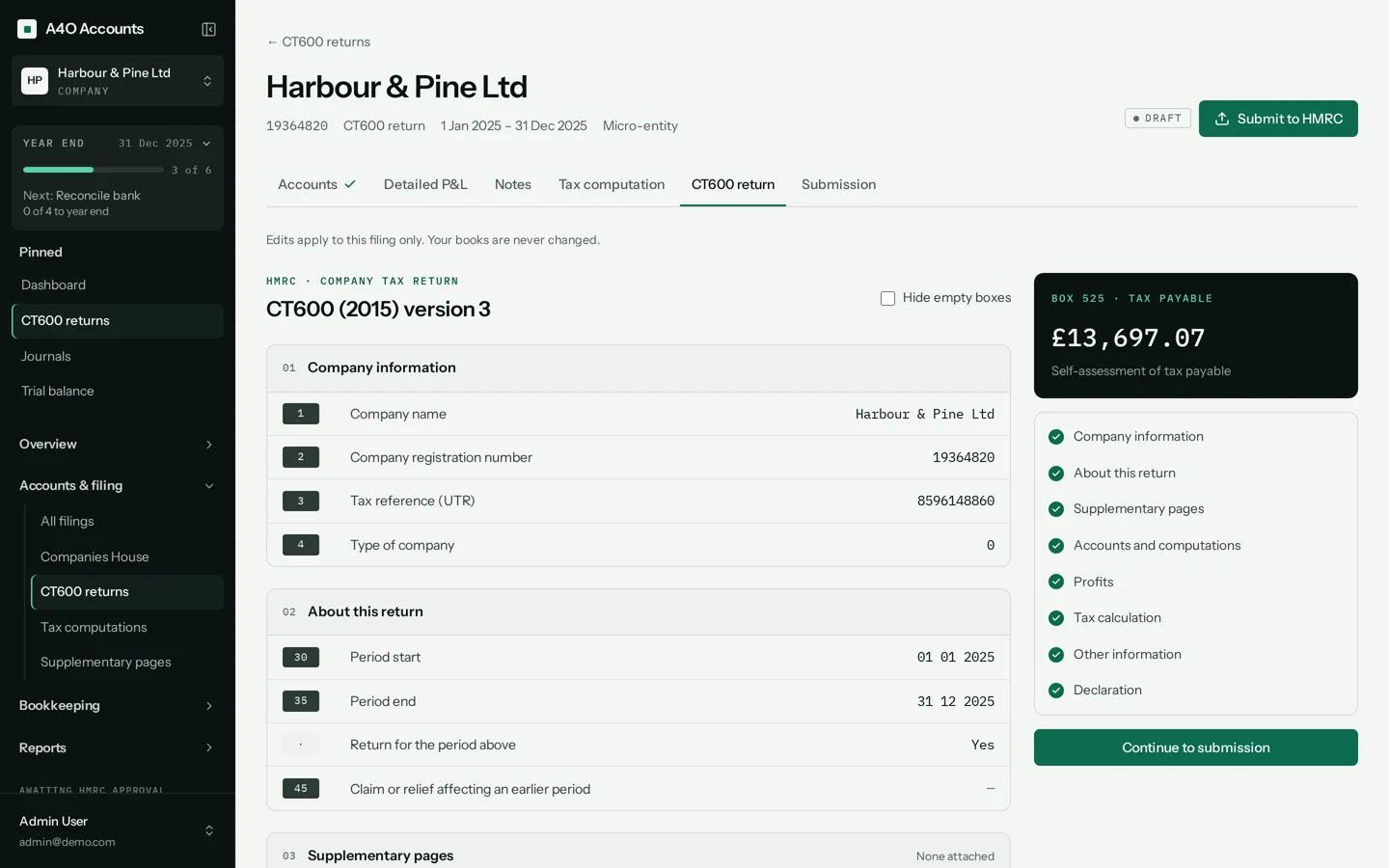
See CT600 software for what it covers, or the step-by-step in preparing and filing a CT600.
More in this series: all the CT600 guides.
File your accounts and Company Tax Return from one set of books
A4O Accounts prepares your accounts and CT600 from the same figures, tags them in iXBRL and files them with Companies House and HMRC. Free to get started, no card required.
Get started freeSources
- GOV.UK — Company Tax Returns
- GOV.UK — Completing your Company Tax Return
- GOV.UK — Company Tax Return (CT600)
This guide is general information, not tax or legal advice. Rules change, so check GOV.UK or ask an accountant about your company’s situation.